LISTENING 8 (Kooragang Island/Daracon Gate 01/12/2025)

This video captures the sensation and disorientation of moving through Pampas (00:25) and Typha (00:40) grass. It was a particularly windy and smoky day with lots of flying insects.

I learnt that although Bell Frogs could be literally found anywhere from the water to high up on tree branches, they are regularly spotted on Typha (or Bullrush) grass.

Over the course of the survey, I occasionally heard researchers and volunteers making a deep “Wuappppp -wup-wup-wup-wup” call then they would listen to hear if any male Green and Golden Bell frogs would respond with their own calls. At 2:15min, you can hear a chorus of human frog calls.

At 03:20min, you see a Peron’s Tree Froglet in metamorphosis. It still has the remnant tadpole tail.

At 04:24min, a Green and Golden Bell frog is spotted sitting in the water.

At 04:40min, another Green and Golden Bell frog is being released back to the spot where it was initially found.
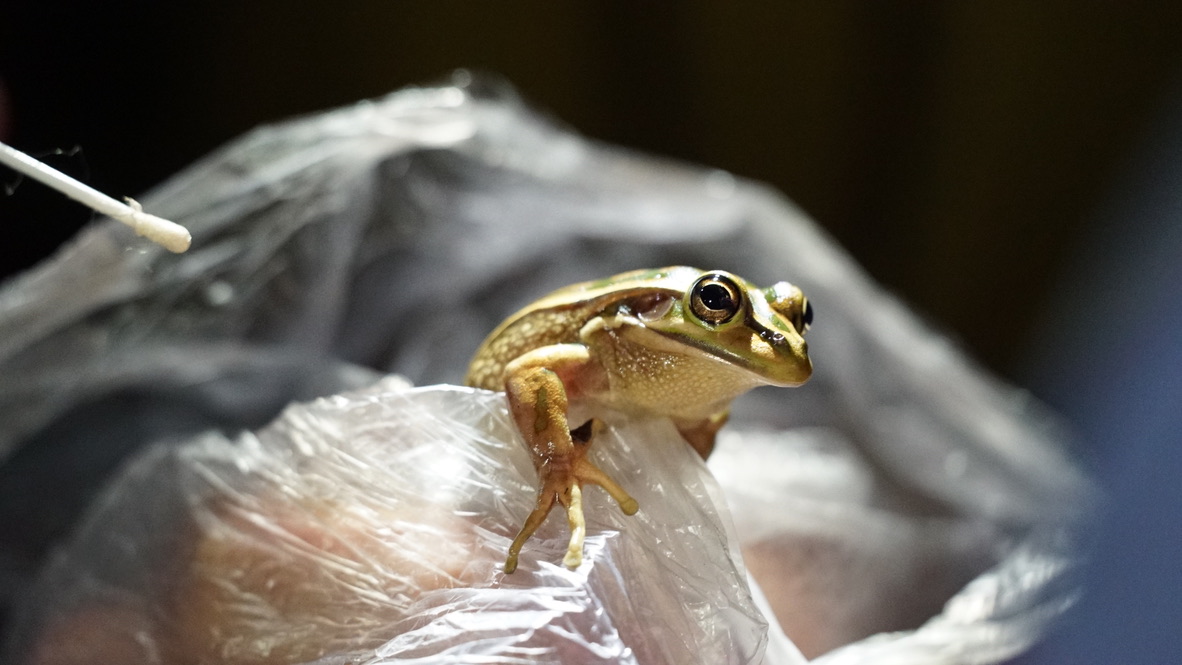
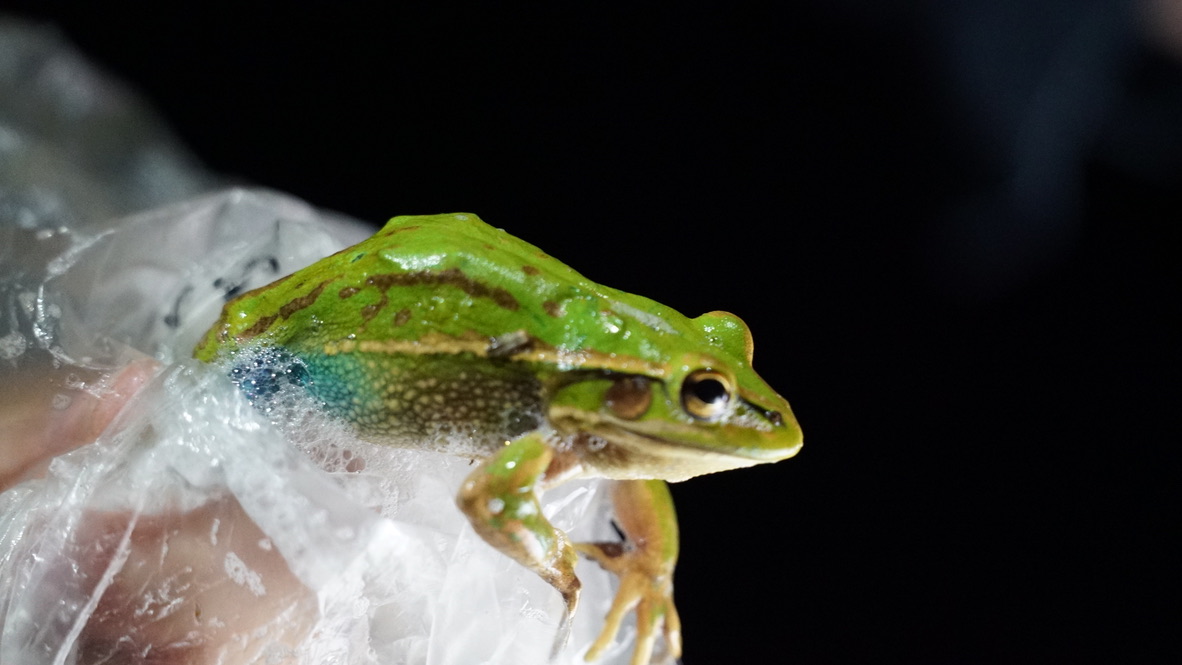
Both of these are male Green and Golden Bell Frogs, note the darker coloured nuptial pads on the top of their thumbs.


LISTENING 9 (Kooragang Island/Windmill Road 02/12/2025)

Although at a lower density compared to some other spots, we saw some Gambusia in the lake which was not ideal for frogs. I learnt that Damsel Fly larvae can sometimes be mistaken for Gambusia, so it was good practice to take photographs to positively identify Gambusia.

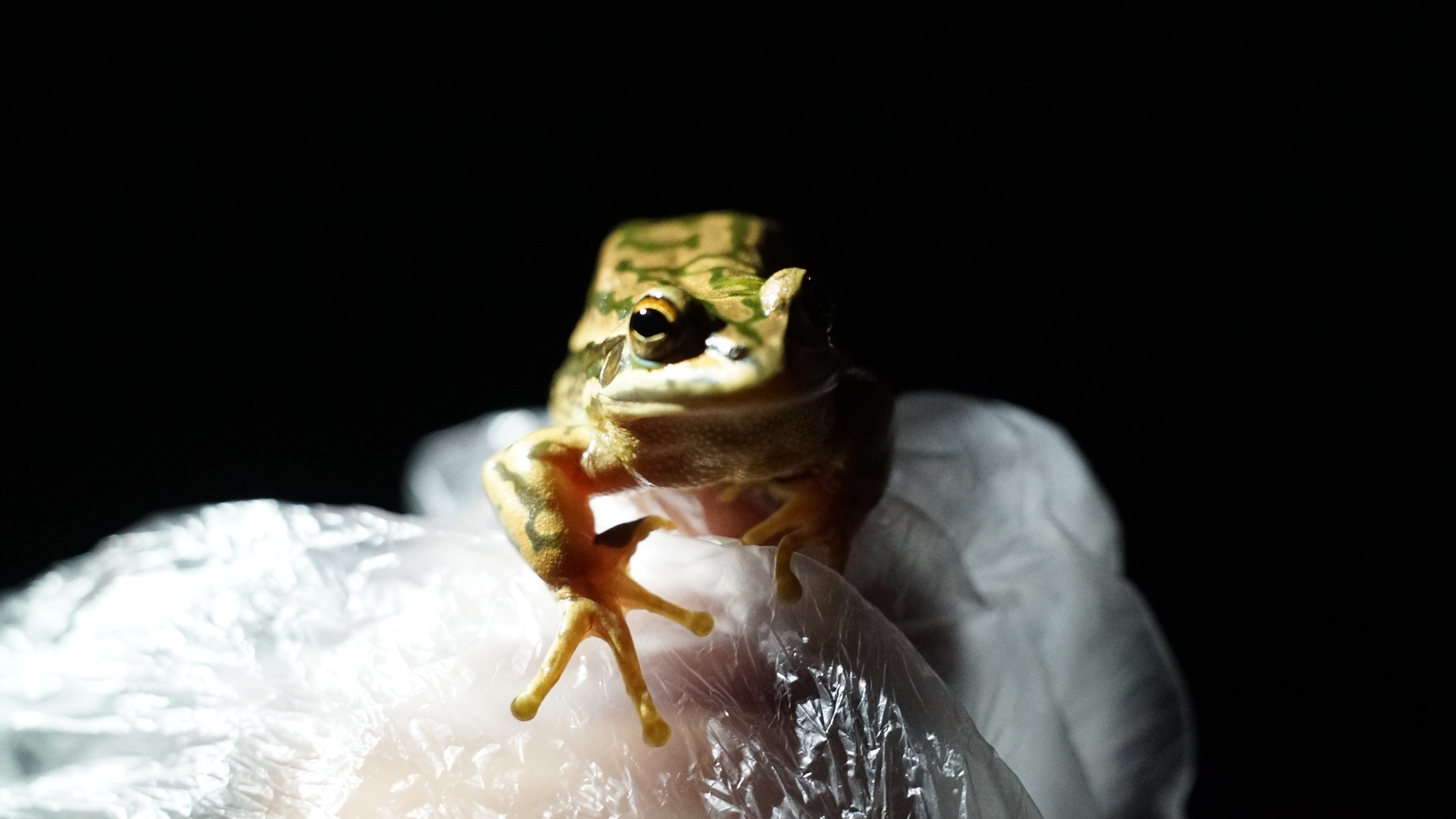
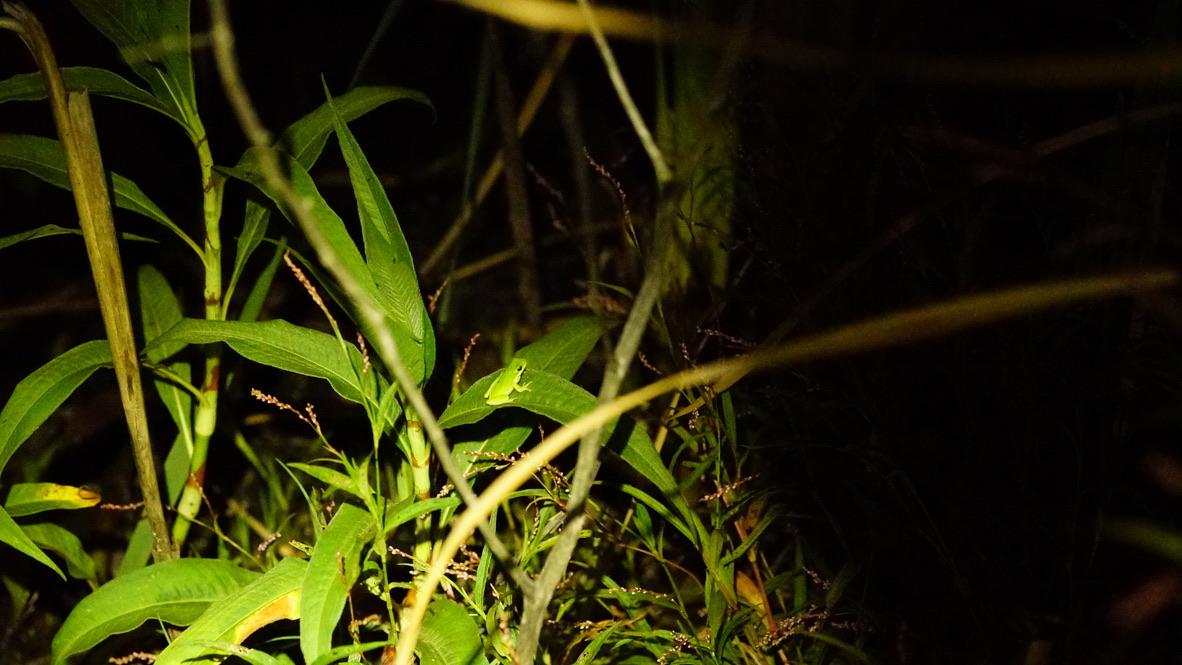
A special moment was when a young Green and Golden Frog started vocalising whilst being swabbed for Chytrid fungus. Whilst looking for Bell frogs, Amanda spotted two Litoria Fallax sitting close to each other. One was an easily recognisable bring green colour but the second frog was a surprising bronze-grey colour. A dark bronze stripe from the tip of the snout, some patches on the bronze back, and a white stripe from under the eye to the arm implied that both were Fallax.


LISTENING 7 (East Newcastle)

Whilst catching up with artist friends Angela Tiatia and Kieren Cooney in Newcastle, I met their neighbours Jackie and Steven who were raising rescued tadpoles in the backyard.

Another friend had found these little tadpoles in a gutter they were cleaning out and instead of flushing them away, they rescued the tadpoles and gave them to their friends to look after. It was great to share stories about the Green and Gold Bell frog preservation and research being done nearby on Kooragan Island and the survival of these endangered frogs in the suburbs of Sydney.

Listening in on these different encounters of collective care and neighbourly concern for the environment and frog ecologies of everyday people, researchers, volunteers and academics was enriching on moving.

These unexpected human, animal and landscape relationships speak to the desire to observe, watch and support life in all its varying forms, even in the environmentally compromised and ecologically disturbed places where our communities somehow continue to exist alongside things like extractive mining and toxic manufacturing.


LISTENING 6 (Kooragang Island/Daracon Gate 29/11/2025)


We started with a Marsh Snake (or Black Bellied Swamp Snake – Hemiaspis signata) at 00:00min in the carpark. The primary diet of these snakes are skinks and frogs.

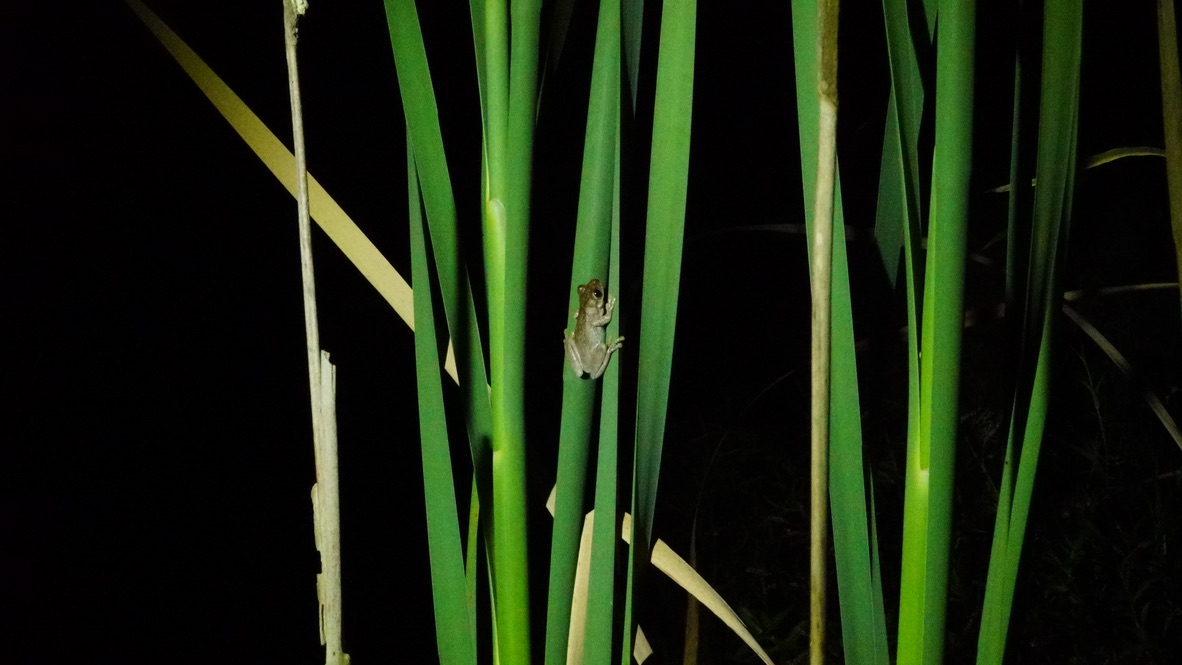
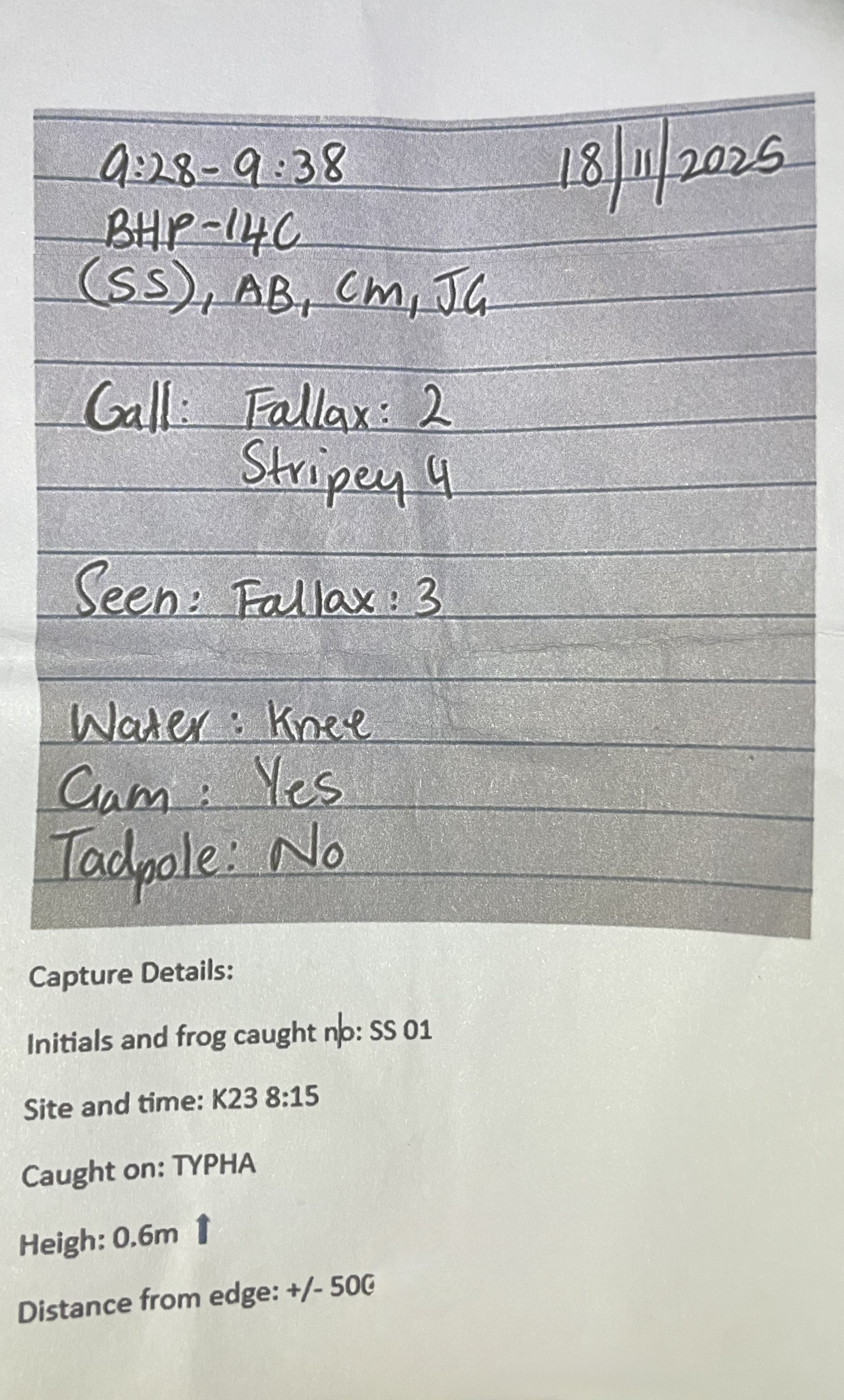
At 01:45min I saw my first Green and Golden Bell Frog sitting on a Typha (Bulrush) reed wit the help of Shannon. Upon capture, a number of details are recorded on the bag:

  • initials of person catching with the numbered frog the person has captured (eg SS 02)
  • Site (Pond name) and time
  • Caught on (plant/tree/water/rock etc)
  • Height from the pond’s water level
  • Distance from the edge of the water.

At 02:40min, there is a Peron’s Tree Frog sitting in the tree.

At 04:00min Colin demonstrates how gravid a female frog look, based on whether her abdomen was full of eggs.

All frogs are returned to the site of capture once data and observations have been collected.

LISTENING 5 (Kooragang Island/Daracon Gate 28/11/2025)

Listening to frog calls:

  • Litoria tyleri (Tyler’s Tree Frog) making a short cackling or drawn out ‘laughing” sound. They sound a lot like the Peron’s Tree Frog and sometimes it is difficult to distinguish between the two.
  • Litoria peronii (Peron’s Tree Frog) also has a cackling / jackhammer call that is has a downward inflection at the end.
  • Litoria fallax (‘Fallax’ or ‘Eastern Dwarf Tree Frog’) “reeek-pip-pip” sound, like a high pitched Guiro instrument or zipper; making a high-pitched “zip” followed by smaller chirps.

At 2:00min you see a Litoria aurea – Green and Golden Bell Frog!!! Notice the bright blue colouring on the legs.

These are collected to record their weight and length. They are also swabbed for Chytrid fungus, micro-chip, have a tissue biopsy, checked for eggs, sex, condition and any scratches of note before being released.

The video ends with some water monitoring. I was shown that you should rinse the the cap out with the water in the pond before testing. Care also needs to be taken to clean and check samplings between ponds to avoid passing on the invasive Gambusia fish between ponds.

This image of a male Green and Golden Bell Frog has distinctive and dark nuptial pad on his thumbs. These help him grab onto the females, and the slight yellow colouration of the neck can help determine his sex.

LISTENING 4 (Kooragang Island/Ash Island 27/11/2025)


I joined researchers and volunteers from the School of Environmental and Life Sciences at the University of Newcastle Australia to observe their fieldwork for a number of nights.

I was introduced to ‘Gam’ or the Gambusia fish (mosquito fish) – 00:37min. At 06:14min, you can spot a Gambusia fish with a fungal infection.

These fish were first introduced to Australia in the 1920s, and then en masse by the Australian government during WWII to biologically control mosquito larvae. In the environment, they do not control mosquitoes anymore than native fish do, and have proliferated to become a pest across  many areas of Australia. Their ability to tolerate poor water quality and live in a wide range of conditions (including high salinity and pollution) combined with their aggressive nature (fin-nipping other fish to make these more prone to infection, preying on native fish eggs, larvae, tadpoles and invertebrates) have exacerbated the decline of many native fish and frog species.

At 02:54min I spotted my first frog, a bright green Litoria fallax – Eastern Dwarf Tree Frog. You can also see a number of Litoria peronii – Peron’s Tree Frog at 03:00min and 07:46min with their distinctive yellow and brown spotted hind legs. And towards the end of this video, you see and hear a Limnodynastes peronii or Striped Marsh Frog at 07:13min.

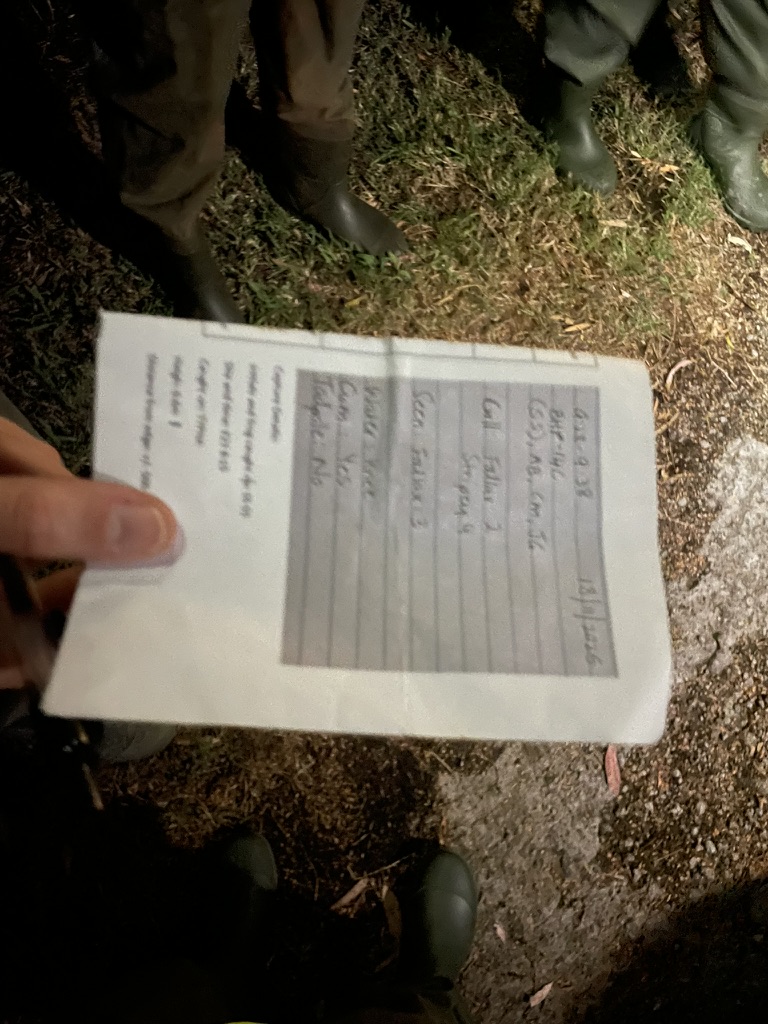
These are environmental and frog capture details that need to be recorded and kept with each frog for data collection.